Looking back as an RD, I never realized I didn't post this...so now that I've been both intern and preceptor for a year, I will share
Happy RD and RD-to-be DAY everyone
It's crazy to think my 1200+ hour dietetic internship is COMPLETE!
My tips for future interns:
1. Approach each rotation with as few preconceived expectations as possible; this does not mean don't review your notes from undergrad to be prepared for the topic. It simply means do not approach a particular rotation with a certain outcome in mind other than to learn from your preceptor. My favorite rotations were the ones that I entered with an open mind and the expectation to complete a project or two that would help my preceptor.
2. Be on top of your meal-prep and laundry...it'll help you save time and money. During my internship, I had rotations for about 40 hours per week (M-F) often with a commute of one-hour each way and an additional 10 hours per week to maintain my assistantship (which provided a full tuition waiver and monthly stipend). I scoured the ads and used M-Perks (Meijer coupons) to save as much as possible. For laundry, I shopped at Goodwill to increase the number of dress pants I had to choose from. Instead of hanging each piece on a separate hanger (skirt on one, blouse another and cardigan a third) hang one whole outfit on the hanger so it's ready to go the next day.
Now that I've served as a preceptor for a dietetic intern myself, I have a few comments to add.
1. I had a really wise moment writing #1 and am not even sure as a preceptor I would have come up with that one!
2. Don't compare yourself to the other interns in your program. Trust that you were selected for the skills you possess and the experiences you bring to the table; on that same note know that the other interns (whether from your program or others) bring their own strengths to each rotation. The internship is stressful enough, the more you can work together, the easier it will be for both of you.
3. Be willing to grow; what you learned in undergrad is the lecture version, the internship is the lab. Each rotation will bring its own challenges and learning opportunities. While some of these may be outside your comfort zone (watching a surgery, counseling patients, discussing recommendations with other providers), being willing to experience them will make your internship more rewarding, and some are likely required.
I want to thank my preceptors at the University of Illinois where I completed my internship as well as to my recent dietetic intern from the University of Florida for providing me the opportunities to learn as both an intern and preceptor.
If you have any other advice for future interns, please feel free to comment.
Wednesday, March 14, 2018

Monday, March 12, 2018
Back in the Saddle Again
After taking a break for just over two years, I have decided to get back to blogging again. During my internship and thesis work, the blog felt more like an assignment than sharing my passion. So I took a break....and here I am back.
A quick view of what I've been doing in the meantime.
March-May2016: Dietetic Internship and presentation of thesis research at Experimental Biology as part of the American Soceity for Nutirtion
March-December 2016: Write and defend thesis including one chapter published in JNEB, study for, take and pass the RD exam on the first try
January-April 2017: Work as a Registered Dietian in a long-term care facility as well as with the after school nutrition education reserach grant that funded my thesis
May-July 2017: Job search and preparing to move to Arizona...no wait Florida (post to come)!
July 2017: Move to central Florida
Fall 2017: Start my first full-time job, survive a hurricane and get engaged!
Be on the lookout for the first full post next Wednesday for RD Day!
A quick view of what I've been doing in the meantime.
March-May2016: Dietetic Internship and presentation of thesis research at Experimental Biology as part of the American Soceity for Nutirtion
March-December 2016: Write and defend thesis including one chapter published in JNEB, study for, take and pass the RD exam on the first try
January-April 2017: Work as a Registered Dietian in a long-term care facility as well as with the after school nutrition education reserach grant that funded my thesis
May-July 2017: Job search and preparing to move to Arizona...no wait Florida (post to come)!
July 2017: Move to central Florida
Fall 2017: Start my first full-time job, survive a hurricane and get engaged!
Be on the lookout for the first full post next Wednesday for RD Day!
Sunday, March 6, 2016
2015 Dietary Guidelines: What Do They Mean
The 2015 Dietary Guidelines for American's (DGA) came out late last year and serve to replace the 2010 version and provide general healthy eating recommendations for Americans.

The DGA are agreed upon by a group of scientists after much deliberation (some of which were open access). DGAs are based on science but also have the influence of industry which is clearly seen this year.
In listening to one of the open committee meetings, dairy (cheese specifically) and sodium were to controversial recommendations. Research on sodium reduction in healthy adults is controversial, while in overweight and obese individuals there can be some health benefits to low sodium diets. With the majority of American's being overweight or obese, there is some merit to the sodium recommendation. Future research is likely to look at the balance of sodium and potassium, both of which are important electrolytes in the body and play a major role in fluid balance.
The bottom line is the DGA aim to be a standardized set of recommendations that apply for most Americans, however, if you would like more personalized nutrition recommendations please find a Registered Dietitian or RD/N.
The DGA are agreed upon by a group of scientists after much deliberation (some of which were open access). DGAs are based on science but also have the influence of industry which is clearly seen this year.
In listening to one of the open committee meetings, dairy (cheese specifically) and sodium were to controversial recommendations. Research on sodium reduction in healthy adults is controversial, while in overweight and obese individuals there can be some health benefits to low sodium diets. With the majority of American's being overweight or obese, there is some merit to the sodium recommendation. Future research is likely to look at the balance of sodium and potassium, both of which are important electrolytes in the body and play a major role in fluid balance.
The bottom line is the DGA aim to be a standardized set of recommendations that apply for most Americans, however, if you would like more personalized nutrition recommendations please find a Registered Dietitian or RD/N.
Tuesday, February 23, 2016
Eating Healthy: Where to Start
Amanda's Healthy Eating Recommendations:
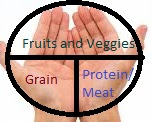
This healthy eating recommendation is a simplified version of MyPlate but also takes into account the size of the person and is a fun demonstration for kids. If after eating the amount of food corresponding to the size of your hands (or plate), you simply have more fruits and vegetables, illustrated to kids by fanning out their hands and wiggling their fingers.
The plate method is a goal for healthy eating and may not be practical as a first step. By setting one small goal at a time and achieving that, adjusting to a more healthful intake can seem more achievable.
This guide serves as a general approach to healthy eating. If you would like more personalized nutrition recommendations please find a Registered Dietitian or RD/N.
- Hold out your hands with palms up and little fingers touching, this is your plate
- One palm represents a grain serving
- Grain or starchy vegetable such as a small baked potato
- The other palm represents a protein or meat serving
- Lean meats are recommended most of the time (chicken, pork, fish, turkey and beef) cooked to maximize flavor an minimize added fat broiled or grilled over fried
- Your fingers represent fruits and vegetables
- These are the non-starchy vegetables (not potatoes or corn)
- Fresh, canned or frozen without added sauces, syrups and rinsed if they're canned vegetables
- Add a side of dairy (yogurt, milk or cheese)

This healthy eating recommendation is a simplified version of MyPlate but also takes into account the size of the person and is a fun demonstration for kids. If after eating the amount of food corresponding to the size of your hands (or plate), you simply have more fruits and vegetables, illustrated to kids by fanning out their hands and wiggling their fingers.
The plate method is a goal for healthy eating and may not be practical as a first step. By setting one small goal at a time and achieving that, adjusting to a more healthful intake can seem more achievable.
This guide serves as a general approach to healthy eating. If you would like more personalized nutrition recommendations please find a Registered Dietitian or RD/N.
Saturday, February 20, 2016
A-Z: Resveratrol
Have you heard that a glass of red wine is comparable to one hour at the gym? Is there any truth to that?

The compound in wine (red wine specifically) that is at the root of this claim is Resveratrol (REZ-VER-A-TR-ALL) and is actually found in other berries, grapes and even peanuts(1). Resveratrol is a type of compound called a polyphenol a type of antioxidant. The notion that red wine has cardiovascular benefits has yet to be proven in large randomized controlled trials. However, red wine has other polyphenollic compounds that have been shown to have health benefits such as anti-inflammatory and anti-atherogenic properties. Sadly, red wine does not have a large concentration of these polyphenols (1).
While red wine may not have all the advantages of an hour of cardio, it has been shown to be one of the more healthful alcoholic beverage choices.
Red Wine Myths:
1. Red wine can prevent cancer
2. All wine tastes better with age
3. The more expensive, the better the wine
In conclusion, drinking one glass of wine on occasion can have some health benefits, drinking should be done in moderation (one drink for women and two for men) and never while pregnant. Written while enjoying a glass of my favorite red.
References:
1. Resveratrol. Linus Pauling Institute. Oregon State University. 2015.
Image

The compound in wine (red wine specifically) that is at the root of this claim is Resveratrol (REZ-VER-A-TR-ALL) and is actually found in other berries, grapes and even peanuts(1). Resveratrol is a type of compound called a polyphenol a type of antioxidant. The notion that red wine has cardiovascular benefits has yet to be proven in large randomized controlled trials. However, red wine has other polyphenollic compounds that have been shown to have health benefits such as anti-inflammatory and anti-atherogenic properties. Sadly, red wine does not have a large concentration of these polyphenols (1).
While red wine may not have all the advantages of an hour of cardio, it has been shown to be one of the more healthful alcoholic beverage choices.
Red Wine Myths:
1. Red wine can prevent cancer
2. All wine tastes better with age
3. The more expensive, the better the wine
In conclusion, drinking one glass of wine on occasion can have some health benefits, drinking should be done in moderation (one drink for women and two for men) and never while pregnant. Written while enjoying a glass of my favorite red.
References:
1. Resveratrol. Linus Pauling Institute. Oregon State University. 2015.
Image
Tuesday, February 9, 2016
The Brisk Pace of Acute Care
I began my in-patient clinical rotation in early January, hence the lack of posts since then. My clinical site is about 1 hour away from where I live, which makes for early morning. Acute care is the longest rotation, 8 weeks, two of which are staff-relief. The first week was spent with the clinical nutrition manager (CNM) and was focused on building a foundation for the remaining weeks.
Week 1:
Nutrition focused physical exam
Thorough chart reading
Obtaining subjective history, from patient, family and or long term care facility
Assessment chart note
Weeks 2 & 3:
Diabetes and renal with assessments and rescreens of patients on the medical floor
Weeks 4 & 5:
Oncology and surgical assessments and rescreens with an intro to nutrition support
Week 6 (this week):
ICU nutrition support during critical care
Each week the CNM and I review two notes and discuss any and all aspects of the patient and why I chose the given diagnosis. Each day includes discussions of the metabolic state of patients with medication interactions and altered needs due to disease(s).
I am thankful that my acute care rotation is later in my internship, as I have had experience working with other members of the medical team and patient interactions prior.
So far the most interesting highlight has been working with the speech therapist. She let me observe a video swallow study and explained each component. In relation to another patient she explained the difference in a swallow study of a patient post-stroke compared to a patient who has a neuro-degenerative disease (such as Parkinson's). It was important to learn this as the diet order and nutritional concerns for these two diagnoses vary.
Week 1:
Nutrition focused physical exam
Thorough chart reading
Obtaining subjective history, from patient, family and or long term care facility
Assessment chart note
Weeks 2 & 3:
Diabetes and renal with assessments and rescreens of patients on the medical floor
Weeks 4 & 5:
Oncology and surgical assessments and rescreens with an intro to nutrition support
Week 6 (this week):
ICU nutrition support during critical care
Each week the CNM and I review two notes and discuss any and all aspects of the patient and why I chose the given diagnosis. Each day includes discussions of the metabolic state of patients with medication interactions and altered needs due to disease(s).
I am thankful that my acute care rotation is later in my internship, as I have had experience working with other members of the medical team and patient interactions prior.
So far the most interesting highlight has been working with the speech therapist. She let me observe a video swallow study and explained each component. In relation to another patient she explained the difference in a swallow study of a patient post-stroke compared to a patient who has a neuro-degenerative disease (such as Parkinson's). It was important to learn this as the diet order and nutritional concerns for these two diagnoses vary.
Tuesday, January 5, 2016
A-Z Quality Foods not Fad Foods
As the new year has turned, million of Americans have made resolutions to lose weight or eat healthy, I encourage you to throw out the traditional resolution! That's right, THROW OUT YOUR HEALTHY RESOLUTION!
No gluten free this (unless you have Celiac Disease) or low fat that! And forget the diet products!!
Instead, I encourage you to make one small goal today! Work on this goal for one month! If you meet this goal, set a new one taking another step towards improved health!

One examples of small goals are:
No gluten free this (unless you have Celiac Disease) or low fat that! And forget the diet products!!
Instead, I encourage you to make one small goal today! Work on this goal for one month! If you meet this goal, set a new one taking another step towards improved health!

One examples of small goals are:
- Swap out two salty snacks per week for one piece of fruit
- Exchange fruit infused water (or plain water) for one soda (regular or diet) once per day
- Two days per week park at the opposite end of the parking lot
These small changes can be made more successful by working with a Registered Dietitian! He or she can help you get healthier for the new year!
Checkout more healthful eating tips at eatright.org and on the Nutrition Blog Network all blogs are authored by Registered Dietitians.
Wednesday, November 4, 2015
A-Z: Packing it
One way I've saved money during my dietetic internship is to...
Pack A Lunch!
Yes that's right, brown bagging it can save a pretty penny and also allows me to customize what I eat to allow for variety of foods.
I try to pack a balanced lunch and aim to include two of the three: diary, fruit or vegetable. I find that a light lunch with a bit more protein (usually Greek yogurt or cheese stick) keeps me fueled for my afternoon but not into a food coma....where I struggle to keep my eyes open during my afternoon activities.
In the warmer months, I would choose a salad or pita sandwich as a great way to pack a lunch. I like to add a Laughing Cow, Spreadable Cheese Wedges , slice of havarti cheese, and ham.


Unfortunately, the warmer months are not currently around, and soups are my fall and winter go to. In this lunch, I packed celery with peanut butter, grapes, and a chicken pot-pie soup.

Packing lunches can take a bit of time, but if fruits and vegetables are cut and packaged the evening before, they can quickly be combined to pack a quick lunch before heading to work.
I'd love to hear your ideas for quick and easy lunches that carry their nutritional weight.
Pack A Lunch!
Yes that's right, brown bagging it can save a pretty penny and also allows me to customize what I eat to allow for variety of foods.
I try to pack a balanced lunch and aim to include two of the three: diary, fruit or vegetable. I find that a light lunch with a bit more protein (usually Greek yogurt or cheese stick) keeps me fueled for my afternoon but not into a food coma....where I struggle to keep my eyes open during my afternoon activities.
In the warmer months, I would choose a salad or pita sandwich as a great way to pack a lunch. I like to add a Laughing Cow, Spreadable Cheese Wedges
, slice of havarti cheese, and ham.

Then fill with baby spinach.

Sometimes I'd fine myself getting tired of salad in the summer. When this happens, I try to mix up the dressing. In this salad, I used Bean & Corn Salsa , shredded cheese and plain Greek yogurt as a dressing for the salad. It can even be topped with more black beans, corn and tortilla chips.
, shredded cheese and plain Greek yogurt as a dressing for the salad. It can even be topped with more black beans, corn and tortilla chips.

Unfortunately, the warmer months are not currently around, and soups are my fall and winter go to. In this lunch, I packed celery with peanut butter, grapes, and a chicken pot-pie soup.

Packing lunches can take a bit of time, but if fruits and vegetables are cut and packaged the evening before, they can quickly be combined to pack a quick lunch before heading to work.
I'd love to hear your ideas for quick and easy lunches that carry their nutritional weight.
Wednesday, October 28, 2015
Graduate Research Presentation
Earlier this month, I had the opportunity to present a piece of my graduate research at the Academy of Nutrition's Food and Nutrition Conference and Expo or FNCE for short. It was my first time presenting at or attending this conference and it was sure a great experience.


I was able to present the poster twice, once during the poster session and once as an award winner at a breakfast for the Research Dietetic Practice Group.

While at the conference, I was also able to enjoy a dinner with graduate student friends where I had the opportunity to try alligator, lobster mac and cheese, and other great new food combinations. The last day coffee was definitely in-hand.

Wednesday, October 21, 2015
A-Z: Omega-3 Fatty Acids
Omega-3 fatty acids have been linked to several health benefits including lowering blood pressure, lowering triglycerides, and decreasing the symptoms of rheumatoid arthritis (1).
There are actually two types of omega-3 fatty acids, EPA (eicosapentaenoic acid) and DHA (docosahexaenoic acid). It is recommended to consume fish twice per week, but there are other foods that contain omega-3 or the precursor to omega-3 including flax seed and chia seed.


Omega-3 fatty acids work, in part, to decrease inflammation and decrease the levels of low-density lipoprotein (LDL) or bad cholesterol in the blood.


This post only contains general nutrition information and is not meant to provide personalized nutrition recommendations. If you have questions about weight loss or personal nutrition recommendations, please see a registered dietitian or your healthcare provider.
Resources
1. Omega-3 Fatty Acids. Mayo Clinic. 2015.
There are actually two types of omega-3 fatty acids, EPA (eicosapentaenoic acid) and DHA (docosahexaenoic acid). It is recommended to consume fish twice per week, but there are other foods that contain omega-3 or the precursor to omega-3 including flax seed and chia seed.
If you're not a fan of fish, chia seeds can be added to smoothies and milled flax can be added to granola or even some baked goods.
Resources
1. Omega-3 Fatty Acids. Mayo Clinic. 2015.
Wednesday, September 23, 2015
A-Z: "Natural"
Food packaging terms like "Natural", "Raw, and "Organic" all have different meanings and levels of regulation!


Last year I lead a discussion group for undergraduate nutrition students and this is one of the handouts I generated for them. It is the truth about the regulation behind certain label claims and I hope it helps you know what you are getting at the grocery store.
Monday, September 14, 2015
Dietetic Internship Reflections
It's hard to believe that I'm three weeks into my dietetic internship through the University of Illinois. My first rotation was at a local dialysis center. I was able to observe both hemodialysis and peritoneal dialysis as well as the multitude of medication associated with each. Assignments included: case studies, bulletin board, renal friendly recipe and educational materials.
My second rotation was at Hy-Vee (a grocery store) about an hour away. It was interesting to learn the dynamic role of a dietitian in a retail environment, and the store I was at actually had 2 full-time dietitians. The longer hours of the retail environment in addition to the commute made for two exhausting weeks.
The remainder of my rotations this semester are local. That being said, I will try to keep this blog updated as best as possible, but some weeks are busier than others.
My second rotation was at Hy-Vee (a grocery store) about an hour away. It was interesting to learn the dynamic role of a dietitian in a retail environment, and the store I was at actually had 2 full-time dietitians. The longer hours of the retail environment in addition to the commute made for two exhausting weeks.
The remainder of my rotations this semester are local. That being said, I will try to keep this blog updated as best as possible, but some weeks are busier than others.
Monday, August 24, 2015
A-Z: MCT Oil
What does MCT stand for?
MCT stands for medium-chain triglyceride, a type of saturated fatty acid containing 6-10 carbon atoms. MCT can be naturally occurring as in the case of coconut oil and some dairy products, but can also be synthesized.
MCTs are absorbed differently than other types of fat, due to their smaller size, they can be directly absorbed, while other fats are grouped together into micelles and absorbed into the lymphatic system(1).
Health associations:
If you walk down the supplement aisle at the grocery store or browse through a health magazine, you're likely to see claims of MCT or coconut oil and weight loss among others. But does the science really support such claims?
First, let's discuss the composition of fats in foods. Nearly all fat containing foods contain more than one type of fat. Coconut oil is no exception. As illustrated above, coconut oil does contain some MCT (listed as caproic acid, caprylic acid, and capric acid), but it is not the primary type of fat. Does this mean coconut oil is bad? Not necessarily.
In conclusion, MCT is a type of fat, while there may be some research to support its links to weight steadiness, it is still a type of fat and must be examined in the larger context of the diet of the indidual. Above all, a healthy balanced diet with lean protein choices, low-fat dairy, whole grains, fruits and vegetables is recommended for most Americans. If you have questions about what this diet may look like for you, I encourage you to meet with a dietitian in your area, you can find one here.
Resources:
1. Bach AC, Babayan VK. Medium-chain triglycerides: an update. American Journal of Clinical Nutrition. 1982.
MCT stands for medium-chain triglyceride, a type of saturated fatty acid containing 6-10 carbon atoms. MCT can be naturally occurring as in the case of coconut oil and some dairy products, but can also be synthesized.
MCTs are absorbed differently than other types of fat, due to their smaller size, they can be directly absorbed, while other fats are grouped together into micelles and absorbed into the lymphatic system(1).
Health associations:
If you walk down the supplement aisle at the grocery store or browse through a health magazine, you're likely to see claims of MCT or coconut oil and weight loss among others. But does the science really support such claims?

First, let's discuss the composition of fats in foods. Nearly all fat containing foods contain more than one type of fat. Coconut oil is no exception. As illustrated above, coconut oil does contain some MCT (listed as caproic acid, caprylic acid, and capric acid), but it is not the primary type of fat. Does this mean coconut oil is bad? Not necessarily.
In conclusion, MCT is a type of fat, while there may be some research to support its links to weight steadiness, it is still a type of fat and must be examined in the larger context of the diet of the indidual. Above all, a healthy balanced diet with lean protein choices, low-fat dairy, whole grains, fruits and vegetables is recommended for most Americans. If you have questions about what this diet may look like for you, I encourage you to meet with a dietitian in your area, you can find one here.
Resources:
1. Bach AC, Babayan VK. Medium-chain triglycerides: an update. American Journal of Clinical Nutrition. 1982.
Friday, August 14, 2015
Additions to "Food & Nutrition Resources"
With the upcoming fall semester, I have chosen to modify the contents of the "Food & Nutrition Resources" tab to include one of my Pintrest boards. I hope to include follow-ups of the recipes I try, specifically how they hold up for lunches while at work. Below are a few boards that have various recipes of personal interest, I hope you find them useful.
Wednesday, August 12, 2015
A-Z: Lactose
What is lactose?
Lactose is a disaccharide sugar made of glucose and galactose. It is the sugar found in milk products from humans and many mammals (including cows) (1).

What is lactose intolerance?
Lactose is normally digested by the lactase enzyme. Lactase breaks the bond (shown in red above) allowing each of the simple sugars to be readily absorbed in the intestines or fermented by intestinal bacteria. Without lactase (or adequate amounts of lactase), gastro-intestinal symptoms of gas, bloating, and cramps. Individuals with lactose intolerance may consume dairy alternatives or take lactase (pill or powder) prior to consuming dairy foods.
 This information is not meant for medical treatment but rather general information. If you have concerns, please discuss them with your healthcare provider.
References
1. Adan AC, Rubio-Texeria M, Polaina J. Lactose: the milk sugar from a biotechnological perspective. Crit Rev Food Sci Nutr. 2004;44(7-8):553-537.
Lactose is a disaccharide sugar made of glucose and galactose. It is the sugar found in milk products from humans and many mammals (including cows) (1).

What is lactose intolerance?
Lactose is normally digested by the lactase enzyme. Lactase breaks the bond (shown in red above) allowing each of the simple sugars to be readily absorbed in the intestines or fermented by intestinal bacteria. Without lactase (or adequate amounts of lactase), gastro-intestinal symptoms of gas, bloating, and cramps. Individuals with lactose intolerance may consume dairy alternatives or take lactase (pill or powder) prior to consuming dairy foods.
References
1. Adan AC, Rubio-Texeria M, Polaina J. Lactose: the milk sugar from a biotechnological perspective. Crit Rev Food Sci Nutr. 2004;44(7-8):553-537.
Wednesday, August 5, 2015
A-Z: Jasmine
I had planned to write short post on some of the benefits of Jasmine tea. However, I was unable to find reputable sources for such a post.
If there is a J related post you'd like to see, please comment below.
If there is a J related post you'd like to see, please comment below.
Monday, August 3, 2015
A-Z: Keeping Track
Keeping Track: Fitness Trackers and Other Gadgets
In the last 5 years, I've noticed an increasing trend of hyper-awareness as it comes to keeping track of one's health. This began in the early 2000's actually when McDonald's and other restaurants began including pedometers with some special meals. Recently, the trend has spanned to calorie tracking apps and fitness trackers that will track your heart-rate.


In the last 5 years, I've noticed an increasing trend of hyper-awareness as it comes to keeping track of one's health. This began in the early 2000's actually when McDonald's and other restaurants began including pedometers with some special meals. Recently, the trend has spanned to calorie tracking apps and fitness trackers that will track your heart-rate.
My questions when it comes to fitness and diet trackers center around the motivation for using them and the knowledge of recommendations for healthy levels. For example, it is recommended that one get 10,000 steps per day as part of an active healthy lifestyle.

Additionally some diet or food tracking apps severely underestimate the number of calories needed for daily activities. Personally, I don't enjoy feeling as though I have a calorie budget, I prefer to eat by the 80:20 rule. Striving for 80% healthful choices and 20% foods because I enjoy them (some healthful some not so much), allows me to enjoy the foods I eat without feeling restricted.
I do monitor my steps, but only through my phone's built in pedometer. I strive for 10,000 before going to the gym!
What are your preferred ways of tracking your activity?
*I am not a medical professional and these opinions are not meant to provide a prescription of any kind. Please speak with a Registered Dietitian or your primary care physician if you have questions concerning your diet or activity level.
Monday, July 27, 2015
A-Z: Iron
Why is Iron Important?
Iron serves multiple functions in the body, but one of the most important is that in the form of hemoglobin within red blood cells. Hemoglobin is needed for oxygen to bind to the red blood cell and be carried to where it is needed within the body (1).

How do I consume iron?
There are two dietary forms of iron, heme and non-heme. Non-heme iron is found in plant sources while animal products contain both heme and non-heme iron. Non-heme iron is not absorbed as well as heme iron, but absorption can be increased by eating iron containing plant foods (spinach, beans, tofu and iron fortified foods) by eating them with Vitamin C containing foods (orange juice, tomatoes or strawberries for example. Red meat and liver are both good sources of heme iron (2).
Symptoms of Deficiency:
References:
1. Iron. MedlinePlus. 2015.
2. Dietary Sources of Iron. University of Illinois McKinley Health Center. 2010.
Iron serves multiple functions in the body, but one of the most important is that in the form of hemoglobin within red blood cells. Hemoglobin is needed for oxygen to bind to the red blood cell and be carried to where it is needed within the body (1).

How do I consume iron?
There are two dietary forms of iron, heme and non-heme. Non-heme iron is found in plant sources while animal products contain both heme and non-heme iron. Non-heme iron is not absorbed as well as heme iron, but absorption can be increased by eating iron containing plant foods (spinach, beans, tofu and iron fortified foods) by eating them with Vitamin C containing foods (orange juice, tomatoes or strawberries for example. Red meat and liver are both good sources of heme iron (2).
Symptoms of Deficiency:
- Lethargy/tiredness
- Headaches
- Decreased appetite
If you believe you may have iron deficiency, please consult your primary healthcare provider.
References:
1. Iron. MedlinePlus. 2015.
2. Dietary Sources of Iron. University of Illinois McKinley Health Center. 2010.
Wednesday, July 22, 2015
A-Z: Hydrogenation
What is Hydrogenation (1)?
Hydrogenation is the process of adding hydrogen to a substance. In the food industry this is done to make fats more stable and avoid rancidity (or the off-flavor that comes from bad oil). There are different levels to which this can be done.
Partial Hydrogenation: Some but not all of the chemical bonds receive hydrogen resulting in an altered structure called trans, thus the name trans-fats. These fats have a longer shelf-life and improve the overall stability of packaged products.
Full Hydrogenation: All of the chemical bonds receive hydrogen resulting in a fully saturated structure. These products are more stable than the original oil form, but not as stable as their partially hydrogenated counterparts.

Hydrogenation and Health:
Partially hydrogenated fats, or trans fats have been linked to increased LDL cholesterol which increases risk of cardiovascular disease. A food may have 0g trans fat listed but under the ingredients have "Partially Hydrogenated Oil" listed, this indicates that the product contains <0.5g trans fat per serving (1).

Now as indicated in the Beta Carotene post, it is important to consume dietary fat. It's essential for the absorption of fat soluble vitamins A, D, E, K. Recommendations are to consume unsaturated fats and some saturated fats.
References:
1. Talking About Trans Fat: What You Need to Know. FDA. 2015.
Hydrogenation is the process of adding hydrogen to a substance. In the food industry this is done to make fats more stable and avoid rancidity (or the off-flavor that comes from bad oil). There are different levels to which this can be done.
Partial Hydrogenation: Some but not all of the chemical bonds receive hydrogen resulting in an altered structure called trans, thus the name trans-fats. These fats have a longer shelf-life and improve the overall stability of packaged products.
Full Hydrogenation: All of the chemical bonds receive hydrogen resulting in a fully saturated structure. These products are more stable than the original oil form, but not as stable as their partially hydrogenated counterparts.

Hydrogenation and Health:
Partially hydrogenated fats, or trans fats have been linked to increased LDL cholesterol which increases risk of cardiovascular disease. A food may have 0g trans fat listed but under the ingredients have "Partially Hydrogenated Oil" listed, this indicates that the product contains <0.5g trans fat per serving (1).

Now as indicated in the Beta Carotene post, it is important to consume dietary fat. It's essential for the absorption of fat soluble vitamins A, D, E, K. Recommendations are to consume unsaturated fats and some saturated fats.
References:
1. Talking About Trans Fat: What You Need to Know. FDA. 2015.
Monday, July 20, 2015
A-Z: Gluten
What is Gluten?
Gluten is a protein found in grains (wheat, barley and rye). Oats themselves do not contain gluten, but are commonly milled in facilities that mill wheat and thus are often contaminated. It is actually made from two smaller proteins gliadin and glutenin, the combination of these two provides the structure for yeast breads (1).
What's the beef with gluten?
Individuals with Celiac Disease have a reaction to gluten in the small intestine that causes inflammation and flattening of the absorptive cells. This means that nutrients aren't being absorbed properly but also leads to GI distress when consumed. Celiac Disease can only be diagnosed with a blood antibody blood test (2).


Gluten is a protein found in grains (wheat, barley and rye). Oats themselves do not contain gluten, but are commonly milled in facilities that mill wheat and thus are often contaminated. It is actually made from two smaller proteins gliadin and glutenin, the combination of these two provides the structure for yeast breads (1).
What's the beef with gluten?
Individuals with Celiac Disease have a reaction to gluten in the small intestine that causes inflammation and flattening of the absorptive cells. This means that nutrients aren't being absorbed properly but also leads to GI distress when consumed. Celiac Disease can only be diagnosed with a blood antibody blood test (2).

Definitions of importance (2):
Allergy: hypersensitivity cause by immune related reaction, can be life-threatening
Intolerance: abnormal response to a food or ingested substance (not immune related)
Sensitivity: larger categorical term that includes both allergies and intolerances
Why might those without Celiac "feel better" on a gluten free diet?
There are several possible reasons for this. A common reason is that a gluten free diet is more in line with MyPlate recommendations than the average American diet: meaning it is higher in fruits and vegetables and lower in refined grains and processed foods. Also, by consuming a gluten free diet, many convenience foods are eliminated as the sauces commonly contain gluten.
There are some anecdotal links between gluten intolerance and neurological conditions, however, the research on these associations is unclear (3).
Cooking and baking for those with Celiac Disease:
Wheat flour is incredibly universal in its application to baking. For this reason, baking gluten free items takes a bit more science (some companies have already taken the guess work out of this). Ingredients like tapioca starch, potato starch, brown rice flower, sorghum flour, xanthan gum and almond flour are combined to create a mixture that functionally resembles wheat flour (without gluten of course). For more on creating the right flour blend for baking see this link.
Verdict on gluten:
If you do not have a gluten allergy such as Celiac Disease, gluten is not bad for you. It is a protein found in grains and can be eaten as part of a balanced healthy diet.
General Food Allergies Informational Site:
References:
1. Gluten Sensitivity. MedlinePlus. 2015.
2. Mahan KL, Swift KM. Medical Nutrition Therapy for Adverse Reactions to Food: Food Allergies and Intolerances. Krause's Food and Nutrition Care Process. 2012.
3. Hadjivassiliou M, Gibson A, Davies-Jones GAB, Lobo, AJ, Stephenson TJ, Milford-Ward A. Does cryptic gluten sensitivity play a part in neurological illness? Lancet. 1996;347(8998);369-371.
Subscribe to:
Posts (Atom)